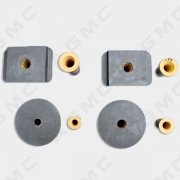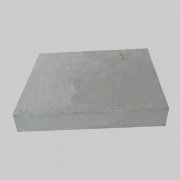
Tundish baking type inorganic magnesium thermal insulation board

The products are mainly used for various varieties of steel continuous casting,tundish lining bag lin-ing and in horizontal continuous casting.This product adopts inorganic adhesive,silica insulation board to avoid eeffect of steel aquatic”increasing silicon hydrogenation”.Improving the cleanliness of steel,because of good heat preservation performance,favorable stability and pull steel speed,improving the yield of liquid steel 0.5-1.0%.At the same time it also can improve the process of masonry remove.package.Product baked 800 to1000’C and 40 minutes can be casting steel.The comprehensive cost saves about thirty percent than magnesia coating cost,It is the current best product of hotpack pouring and tundish bag linging.

Refractoriness


Thermal conductivity


The hot surface temperatureHigh temperature

Ine changes

Flexural strengthResidual moistureLoss on ignitionMgO
>1600℃<0.65W/M.K1000℃0~±0.1%

1500℃x3h

≥4.5Mpa<0.7%<7%65-70%


Continuous casting Tundish modelCS-20 Neutral insulation board

The new CS-20 insulation board my comany with the Wuhan Iron and Steel Group Company second steel works developed jointly,erosion resistant,impact resistant,not fried,indehiscent,with good perf-ormance,thanthe current magnesian insulating board to improve consumer durables erosion 5 times.even more to solve the magnesia board is easy to water,moisture absorptton,pouring boiling serious problem than silica insulation board,provided high resistance to erosion by more than 10 times.in order to improve the continuous casting ladle liquid steel quality,puritying,played a big role.Currently in WISCO,Shougang,TISCO,long dozenA large number of the use of steel,and bring agreat effect for the user.

What is metallurgy

Metallurgy refers to the process and technology of extracting metals or metal compounds from ore and using various processing methods to make metals into metal materials with certain properties. The technology of metallurgy mainly includes pyrometallurgy,hydrometallurgy and electrometallurgy.


Pyrometallurgy means that part or all of the minerals in the ore or concentrate undergo a series of physical and chemical changes at high temperatures to generate another form of compound or element, which are respectively enriched in gas, liquid or solid products, so as to achieve the purpose of separating the extracted metal from gangue and other impurities.


Hydrometallurgy is a process in which the metal to be extracted enters the solution in the form of a certain ion (cation or complex anion), and after these impurities are removed from the solution, the metal is extracted from the purification solution by methods such as replacement, reduction, and electrowinning.


Electrometallurgy mainly has two aspects: electrothermal metallurgy and electrochemical metallurgy. Electrothermal metallurgy refers to the method of converting electric energy into heat energy for smelting. Electrochemical metallurgy mainly includes electrolysis and electrowinning: solution electrolysis makes metal from metal salt-containing solution or melting Precipitation in the body. It can be included in the category of hydrometallurgy; the latter is called molten salt electrolysis, which not only uses the chemical effect of electrical energy, but also uses electrical energy to convert it into heat, so as to heat the metal salt to make it a melt, so it can also be included in the fire method Metallurgical category.

The superiority of spherical refractory aggregate

The good fluidity of spherical materials is well known,and it will be great useful in refractory castable and injection material,such as helping to eliminate dilatation,improve fluidity,and improve structural uniformity,etc.

The thermal insulation lining made of spherical lightweight aggregate has a higher strength than traditional porous lightweight materials because:

  • The pores inside the aggregate are closed and will not cause stress concentration,making the strength of the spherical aggregate itself higher than that of the traditional lightweight aggregate;
  • There are no sharp edges and corners on the surface of the spherical aggregate,and there will be no stress concentration at the aggregate-matrix interface to damage the bond between the aggregate and the matrix;
  • In the thermal insulation lining made of spherical aggregates,the aggregates are tightly combined to increase the strength.This kind of airtight lining is especially suitable for equipment with high temperature,certain pressure,corrosive furnace gas and steam medium.

The advantages of spherical aggregates are not only suitable for castables, but also for shaped products. Spherical aggregates can first be used in occasions that require high fluidity, transportability, air tightness, and heat insulation. With the progress of aggregate engineering, especially the design and customization of the internal and surface of the aggregate, new aggregates will bring more diversified and superior properties to refractories, such as high temperature strength, thermal shock resistance, and flexibility , corrosion resistance, etc.

It is not difficult to predict that spherical aggregates will become a new generation of refractory aggregates instead of traditional aggregates. Its potential market is huge. In most refractory materials including shaped and amorphous, aggregates account for more than 60% .The global average annual consumption of refractory materials in the past ten years has been more than 38 million tons.